
Growth Hormone Peptides
Top 10 CJC 1295 Ipamorelin Benefits People Talk About Online
May
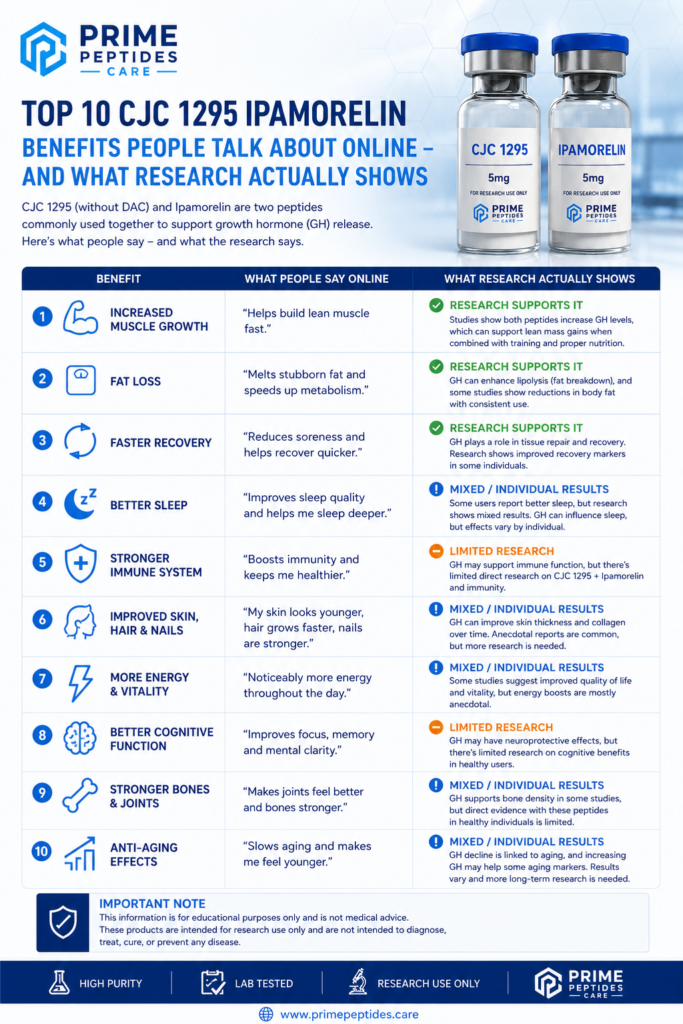
CJC 1295 and Ipamorelin are two growth hormone related peptides that get a lot of attention in forums, clinics, and social media. Many people describe big changes in sleep, body composition, recovery, and energy when these compounds are combined. At the same time, evidence is still evolving, and most controlled data come from limited human studies and preclinical models. This post looks at 10 popular “benefits” people talk about online and compares them with what current research actually suggests in a cautious, research‑only context.
Important: This article is educational only. CJC 1295 and Ipamorelin are prescription‑only in medical settings and sold as research‑use‑only (RUO) compounds by many labs. They are not approved for self‑experimentation or over‑the‑counter medical use.
1. Increased Growth Hormone and IGF‑1
What people say online:
Many users claim that CJC 1295 and Ipamorelin together “boost HGH” more than either compound alone, often quoting big percentage increases.
What research actually shows:
Clinical work with CJC 1295 has shown sustained increases in growth hormone and IGF‑1 after administration, sometimes lasting several days. Ipamorelin, a ghrelin‑receptor agonist, can create sharp, short pulses of growth hormone. In controlled settings, combining a GHRH‑analog like CJC 1295 with a GHRP like Ipamorelin has produced larger growth hormone pulses than either compound alone. However, these effects depend on dose, study design, and medical supervision, and are not the same as unlimited “HGH boosting.”
2. Better Body Composition (Less Fat, More Lean Mass)
What people say online:
A common claim is “leaner, more defined, and less belly fat” after several months on a CJC 1295/Ipamorelin protocol.
What research actually shows:
Growth hormone and IGF‑1 are linked to fat metabolism and lean tissue in both clinical trials and animal models. Some human data using CJC‑type peptides or other GH‑modulators show modest improvements in fat mass and lean body mass, especially when combined with diet and exercise. But results are not guaranteed, vary by person, and long‑term safety for non‑medical use has not been fully defined.
3. Improved Recovery and Exercise Performance
What people say online:
Many users report faster recovery after workouts, less soreness, and better performance when using this peptide pair.
What research actually shows:
Because growth hormone and IGF‑1 play roles in tissue repair and protein synthesis, researchers are interested in how GH‑related peptides might influence muscle recovery markers. Preclinical and limited clinical studies suggest GH axis activation can support aspects of recovery under controlled conditions, but robust human performance trials specifically for CJC 1295/Ipamorelin are still limited. Any performance claims should be treated as hypotheses, not guarantees.
4. Deeper Sleep and Better Sleep Quality
What people say online:
Improved deep sleep, fewer nighttime awakenings, and feeling more rested the next day are among the most frequently reported online benefits.
What research actually shows:
Growth hormone naturally peaks during deep sleep. Some clinical and observational work suggests GH‑axis modulation may influence sleep architecture and subjective sleep quality. Reports from peptide clinics often highlight better sleep in patients, but these are typically uncontrolled case series. So, improved sleep is a plausible effect, but still based largely on small datasets and patient reports rather than large randomized trials.
5. Enhanced Mood and Energy
What people say online:
People often describe feeling more energized, motivated, and “clear‑headed” after several weeks on a CJC 1295/Ipamorelin protocol.
What research actually shows:
Hormones that influence GH and IGF‑1 can interact with metabolism, sleep, and overall vitality, which may indirectly affect mood and energy. Some clinical programs report improved subjective well‑being and fatigue scores, but again, evidence is mainly observational. There is no guarantee that everyone will experience mood or energy benefits, and placebo effects can be strong in this area.
6. Skin, Hair, and “Anti‑Aging” Effects
What people say online:
Smoother skin, better elasticity, fewer wrinkles, and healthier hair are popular claims in marketing and testimonials.
What research actually shows:
GH and IGF‑1 pathways are involved in collagen turnover, skin thickness, and other structural processes. There are small data sets and mechanistic studies suggesting GH‑modulating treatments may influence skin parameters, but long‑term cosmetic benefit claims for CJC 1295/Ipamorelin remain largely anecdotal. Strong “anti‑aging” promises are often marketing language, not fully proven medical facts.
7. Joint Comfort and Soft‑Tissue Support
What people say online:
Some users report less joint discomfort and better tendon or ligament resilience.
What research actually shows:
Animal models and growth‑factor research indicate GH and related peptides can affect connective tissue, cartilage, and collagen. However, rigorous human trials specifically examining joint outcomes with CJC 1295/Ipamorelin are sparse. Any improvement in joint comfort reported by individuals remains preliminary and subjective.
8. Better Metabolism and Weight Management
What people say online:
People often describe easier weight control, improved metabolism, and less central fat, especially when combined with diet and training.
What research actually shows:
Growth hormone influences lipid metabolism, insulin sensitivity, and body composition. Some studies involving GH‑axis manipulation show improvements in certain metabolic markers, but results can be mixed and dose‑dependent. Inappropriate GH stimulation can also negatively impact glucose control in some contexts. For CJC 1295/Ipamorelin specifically, most “metabolism” narratives are extrapolated from general GH biology and clinic experiences rather than large controlled trials.
9. Cognitive Focus and Mental Clarity
What people say online:
Another commonly cited benefit is “better focus, memory, and mental sharpness,” especially after a few months of use.
What research actually shows:
GH and IGF‑1 have roles in brain function and neuroplasticity, and some research explores their influence on cognition and mood. But evidence directly linking CJC 1295/Ipamorelin protocols to consistent cognitive improvements is limited. Any claims about sharper thinking remain tentative and should not be treated as established clinical outcomes.
10. Overall “Vitality” and Quality of Life
What people say online:
Many blogs and clinics describe this combination as a general “vitality booster,” tying together energy, recovery, sleep, body composition, and mood.
What research actually shows:
When GH and IGF‑1 are carefully adjusted under medical supervision for truly deficient patients, improvements in quality‑of‑life scores have been reported. For otherwise healthy people, long‑term safety and benefit‑risk balance of peptide stacks like CJC 1295/Ipamorelin are not fully characterized. Any broad “feel younger” or “total vitality” claims should be viewed as marketing language, not a guarantee.
How to Read Online Claims Carefully
Because CJC 1295 and Ipamorelin are associated with growth hormone, they attract a lot of hype. When reading testimonials or clinic blogs:
- Check whether claims are supported by controlled studies or just personal stories.
- Look for clear statements about research‑only status and medical supervision.
- Be cautious of any source that promises dramatic, guaranteed transformations.
For labs and researchers, the most responsible approach is to treat these peptides as tools for understanding GH‑axis biology, not as consumer lifestyle shortcuts.
