
Growth Hormone Peptides
CJC 1295 + Ipamorelin: What It Is and How It Works (Beginner’s Guide)
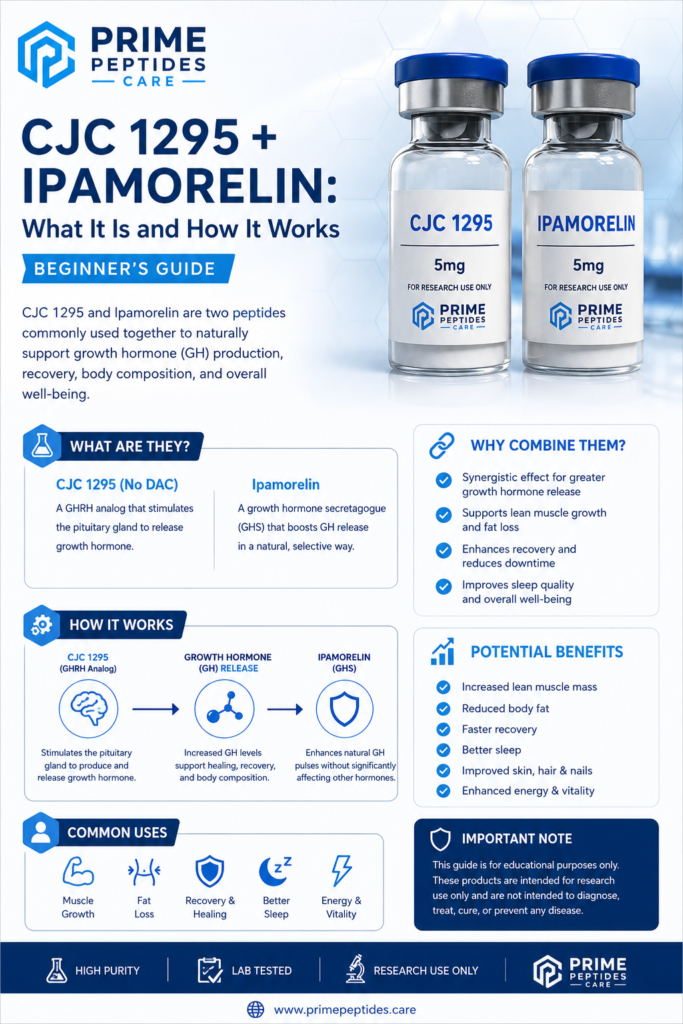
May
Why Everyone Talks About CJC 1295 + Ipamorelin
CJC 1295 and Ipamorelin are two peptides that often appear together in conversations about growth hormone–related research.
When combined, they create a popular “stack” that aims to support natural growth hormone release instead of replacing it directly.
This guide explains, in simple language, what each peptide is, how they work together, and why they’re interesting for laboratory research only.
What Is CJC 1295?
CJC 1295 is a lab‑made peptide designed to act like a growth hormone–releasing hormone (GHRH) analog.
In research models, it binds to GHRH receptors in the pituitary gland and signals that gland to produce and release more growth hormone over time.
Because CJC 1295 is modified to last longer than natural GHRH, it can help create a higher baseline level of growth hormone in experimental settings, often with fewer injections compared to very short‑acting peptides.
Key points about CJC 1295 in research:
- Acts on GHRH receptors in the pituitary
- Used to study sustained or long‑acting growth hormone signaling
- Often associated with gradual, background elevation of GH and IGF‑1 in lab models
What Is Ipamorelin?
Ipamorelin is a growth hormone secretagogue (GHS), sometimes grouped with GHRP‑type peptides.
Instead of mimicking GHRH, it binds to ghrelin receptors (also known as GHS‑R) in the pituitary and hypothalamus.
In research, this binding triggers short, sharp pulses of growth hormone release, similar to the body’s natural GH pulses.
Key points about Ipamorelin in research:
- Mimics ghrelin at specific receptors
- Used to study pulsatile growth hormone release
- Known for being more selective than some older GHRPs, which helps researchers focus on GH without as much impact on other hormones
Why Combine CJC 1295 and Ipamorelin?
On their own, each peptide hits a different part of the growth hormone axis.
Together, they provide a dual‑pathway approach that many researchers find more “physiological” than using a single compound.
A simple way to think about it:
- CJC 1295 = the signal that raises the baseline production of growth hormone
- Ipamorelin = the trigger that creates short bursts or pulses of growth hormone release
In research models, this combination can:
- Support a higher baseline GH/IGF‑1 environment thanks to CJC 1295
- Layer timed pulses of GH release from Ipamorelin
- Help mimic the body’s natural rhythm of steady background + spikes, rather than a flat, constant level
For scientists, this means the stack can be used to study:
- Growth hormone pulsatility
- Metabolic responses such as changes in fat and carbohydrate handling
- Recovery‑ and repair‑related pathways, especially when combined with other research peptides
How Does the Stack Work Step by Step?
- CJC 1295 binds to GHRH receptors
- It signals the pituitary to produce and store more growth hormone.
- Because it is longer‑acting, this effect can last for many hours (and in some clinical settings, days).
- Ipamorelin activates ghrelin (GHS) receptors
- It sends a separate signal that tells the pituitary to release growth hormone already stored.
- This creates pulses of GH that rise and fall rather than staying flat.
- Combined effect
- CJC 1295 increases the amount available, while Ipamorelin controls when it is released.
- Together they create a pattern of higher, pulsed GH output that is closer to the body’s natural behavior than direct injections of synthetic growth hormone.
Common Reasons People Search for This Stack
Online, the CJC 1295 + Ipamorelin combination is often discussed in connection with:
- Body composition research (muscle vs fat)
- Sleep quality and recovery
- Injury and tissue repair models
- General “anti‑aging” interest
It’s important to remember that many of these discussions come from wellness clinics and user anecdotes, not from fully completed large‑scale human trials.
For a research‑only brand like Prime Peptides Care, the focus stays on mechanisms, pathways, and in‑vitro or preclinical models, not on medical promises or treatment claims.
Safety, Ethics, and “Research Use Only”
Because CJC 1295 and Ipamorelin affect hormone pathways, they are not casual supplements.
Regulations in most places treat them as research chemicals, and real medical use should only happen under licensed healthcare supervision where the law allows.
That is why high‑quality labs and peptide suppliers clearly label these products as:
- For in‑vitro research use only
- Not for human or veterinary use
- Not a drug, food, cosmetic, or dietary supplement
For a site like Prime Peptides Care, this clarity helps protect both the researcher and the supplier.
It also keeps the focus where it belongs: on controlled experiments, documented protocols, and reproducible data.
Where a Beginner Should Start (From a Research Perspective)
If someone is new to the topic and wants to learn more at a scientific or educational level, good starting points include:
- Understanding the difference between GHRH analogs (like CJC 1295) and GHRP/ghrelin‑mimetic peptides (like Ipamorelin)
- Reading about growth hormone and IGF‑1 physiology
- Learning how pulsatile hormone release differs from constant infusion
- Reviewing basic lab practices for peptide storage, reconstitution, and handling
This foundation makes it easier to interpret research papers, clinic articles, and product pages without getting lost in marketing hype.
Final Reminder
CJC 1295 and Ipamorelin form a powerful research combination because they work on different receptors but share the same goal: stimulating the body’s own growth hormone system instead of replacing it outright.e body’s own growth hormone system instead of replacing it outright.
