
Growth Hormone Peptides
CJC 1295 vs Ipamorelin vs CJC 1295 + Ipamorelin: Which Stack Do Clinics Prefer?
Jun
Why this stack is so popular
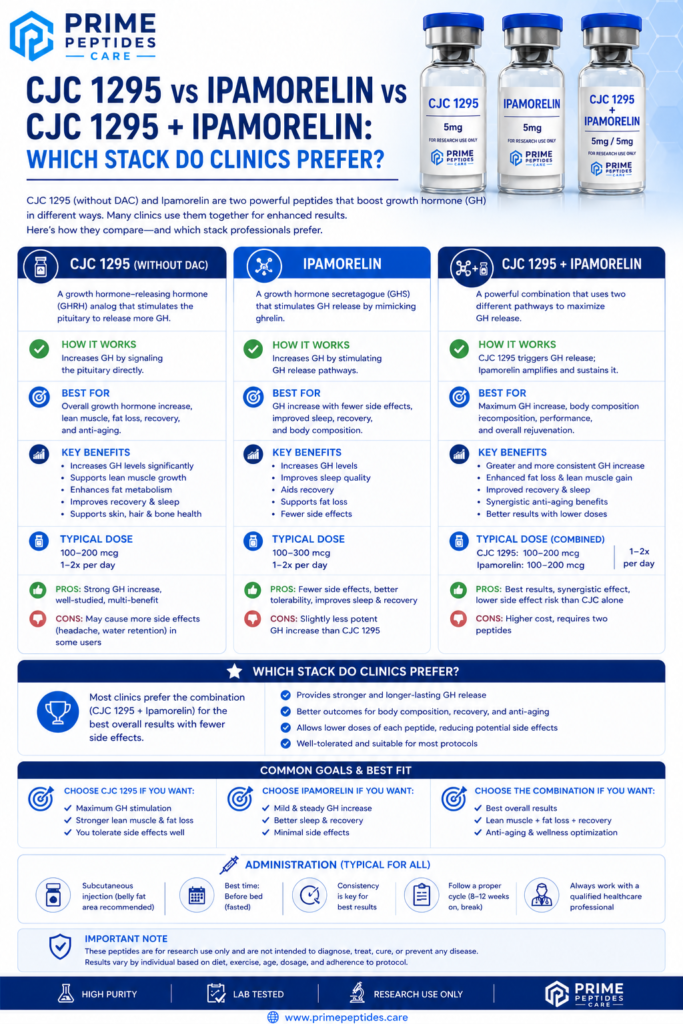
In growth hormone–related peptide research, three names come up over and over: CJC 1295, Ipamorelin, and the CJC 1295 + Ipamorelin stack. Many clinics and researchers talk about this combination because it targets the growth hormone axis from two different angles, creating a pattern of release that looks closer to the body’s natural rhythm. This article compares each option and explains why the combined stack is often preferred in modern protocols. All discussion here is informational only and refers to research and supervised clinical use, not to self‑medication.
CJC 1295 on its own
CJC 1295 is a growth hormone releasing hormone (GHRH) analog. It binds to GHRH receptors in the pituitary and signals the gland to produce more of its own growth hormone over an extended period. In simple terms, CJC 1295 tells the “factory” to increase production. Depending on whether a DAC or no‑DAC form is used, its effect can be relatively long‑acting, which is why many protocols use fewer injections when CJC 1295 is included. Clinics often highlight CJC 1295 for broader, longer‑term goals such as lean mass support, body recomposition, and general anti‑aging style benefits under medical supervision.
Pros clinics see mentioned:
- Supports more sustained growth hormone signaling.
- Fewer injections when a long‑acting form is used.
- Often positioned for long‑term body composition and vitality goals.
Limitations:
- On its own, the pulses of growth hormone may not be as sharp or frequent as some practitioners want.
- Because it focuses on production, not release, it may be less flexible for short windows of recovery or performance.
Ipamorelin on its own
Ipamorelin is a growth hormone secretagogue that acts on ghrelin (GHS‑R) receptors in the pituitary. Instead of driving production over many hours, it creates short, controlled spikes of growth hormone. You can think of Ipamorelin as the “on‑demand” trigger: it tells the “warehouse” to release stored hormone in quick pulses. Many clinic blogs describe it in connection with recovery, sleep, and fat‑loss‑oriented programs because of this pulsed pattern.
Pros clinics see mentioned:
- Short, clean pulses that are easy to time around sleep or training.
- Often discussed for recovery, sleep quality, and body‑fat–focused goals.
- Does not strongly affect other hormones like cortisol in many published protocols.
Limitations:
- Short half‑life means more frequent injections.
- On its own, it may not maintain elevated growth hormone levels for long periods.
Why stack CJC 1295 + Ipamorelin?
When clinics combine CJC 1295 with Ipamorelin, they are deliberately pairing a sustained signal with sharp pulses. CJC 1295 keeps the background production of growth hormone higher, while Ipamorelin provides quick bursts layered on top. Many modern guides describe this as creating a more “physiological” pattern: baseline support plus natural‑style spikes, instead of flat high levels.
Reasons this stack is often highlighted:
- Two different receptors and pathways are activated, which can lead to a stronger overall signal than either peptide alone.
- The pattern of release can be timed to match natural high points (for example, before sleep), while still maintaining a higher baseline.
- Clinics frequently mention this combo when discussing comprehensive goals like improved sleep, recovery, body composition, and performance, always under physician guidance.
Because of this synergy, many practical guides for peptide‑based growth hormone support now treat “CJC 1295 + Ipamorelin” as the default stack, while single‑peptide use is positioned as a lighter or simpler option.
Which stack do clinics seem to prefer?
Looking across public clinic articles and educational content, a clear trend appears:
- CJC 1295 alone is used, but usually for people wanting a simpler, lower‑injection approach or a more gradual change.
- Ipamorelin alone shows up when the focus is on gentle pulses, recovery, or when a very conservative protocol is chosen.
- CJC 1295 + Ipamorelin together is described most often as the “go‑to” stack for comprehensive growth hormone related goals, especially when muscle, fat loss, sleep, and recovery are all mentioned in one program.
For that reason, the combined stack is the option most frequently promoted in clinic blogs and marketing material. That does not mean it is right or safe for everyone; it simply reflects what many clinics publicly say they prescribe most often under medical supervision.
How this ties into Prime Peptides Care
For research‑focused buyers, understanding why clinics prefer the CJC 1295 + Ipamorelin combination helps explain why blended peptides are so popular in laboratory studies. A well‑formulated research blend can:
- Model both baseline and pulsatile growth hormone dynamics in vitro.
- Support experiments that examine multiple signaling pathways at once.
- Reduce handling steps by combining complementary peptides in a single vial.
Any peptide products offered by Prime Peptides Care must always be treated as research‑use‑only materials. They are not medicines and are not intended for human or veterinary use. Proper storage, handling, and compliance with institutional guidelines remain essential.
