
Growth Hormone Peptides
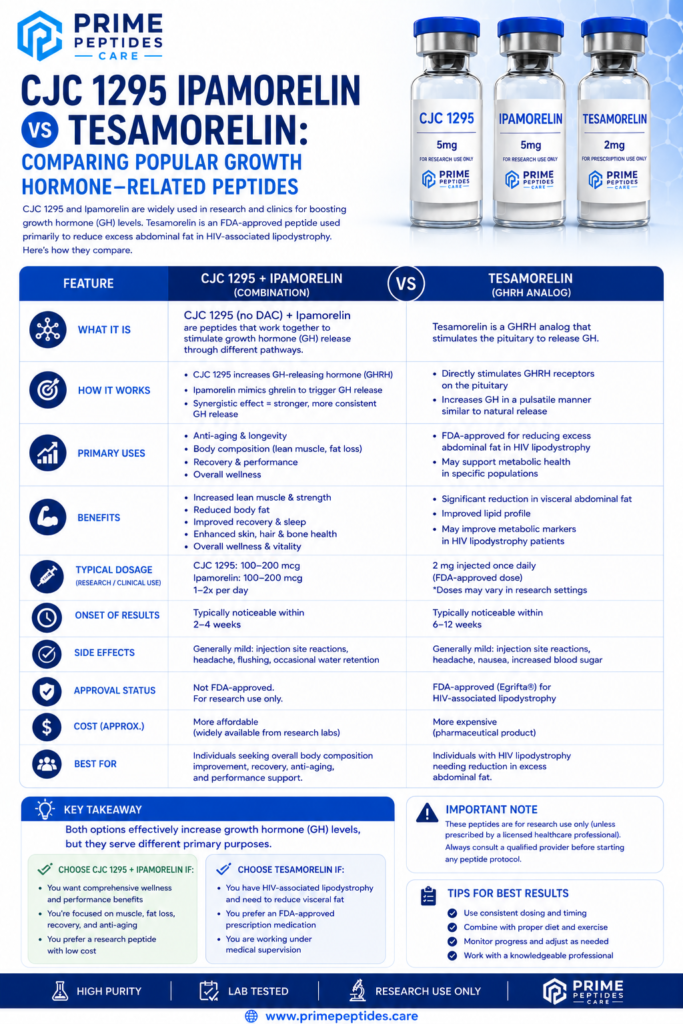
CJC 1295 Ipamorelin vs Tesamorelin: Comparing Popular Growth Hormone–Related Peptides
Jun
Growth hormone–related peptides have become some of the most talked‑about compounds in experimental endocrinology and metabolic research. Among them, CJC 1295 + Ipamorelin and Tesamorelin stand out as two of the most popular options scientists see discussed online. This guide compares how they work, where they are studied, and what makes each peptide unique strictly from a research perspective and for research use only.
What are CJC 1295 and Ipamorelin?
CJC 1295 is a synthetic analog of growth hormone–releasing hormone (GHRH). It is designed to increase the amplitude and duration of natural growth hormone (GH) pulses from the pituitary. Many formulations are modified to extend half‑life, so GH levels can remain elevated for longer with fewer administrations.
Ipamorelin belongs to the growth hormone secretagogue (GHS) family. It acts as a selective ghrelin receptor agonist, stimulating GH release in short “pulses” while having minimal impact on other hormones such as cortisol or prolactin. When researchers combine CJC 1295 and Ipamorelin, the goal is to study a dual approach: CJC 1295 supports baseline GH output, while Ipamorelin sharpens the timing of GH pulses.
Together, the CJC 1295 / Ipamorelin blend is often chosen in research models that focus on recovery, sleep quality, body‑composition changes, and general metabolic regulation rather than a single clinical endpoint.
What is Tesamorelin?
Tesamorelin is also a GHRH analog, but it was developed and clinically approved for a very specific purpose: reducing excess visceral abdominal fat in certain patient populations. In research and clinical literature, Tesamorelin is frequently associated with targeted reductions in deep belly fat, changes in IGF‑1 levels, and improvements in some metabolic markers.
Because of this focused use, Tesamorelin tends to appear most often in studies on visceral adiposity, cardiometabolic risk factors, and body‑fat distribution, rather than as a general “all‑round” peptide.
Mechanism of action: how do they differ?
While both approaches involve growth hormone pathways, their emphasis is different:
- CJC 1295 / Ipamorelin
- CJC 1295 activates GHRH receptors, increasing GH pulse size and duration.
- Ipamorelin activates ghrelin receptors, increasing the frequency of GH pulses.
- In combination, they are used to explore more physiological, pulsatile GH patterns that may impact recovery, sleep, and lean‑mass related endpoints in research models.
- Tesamorelin
- Acts as a GHRH analog with strong, sustained stimulation of GH and IGF‑1.
- Is frequently associated with studies on visceral fat reduction, liver fat changes, and metabolic markers, especially in highly defined clinical populations.
In simple terms: Tesamorelin is usually studied for targeted visceral fat outcomes, while CJC 1295 + Ipamorelin is often used when the goal is a broader GH‑support model in lab settings.
Research focus and common use‑cases
Although protocols vary widely, the research focus typically looks like this:
- CJC 1295 / Ipamorelin research themes
- Sleep quality and circadian GH pulse patterns
- Exercise recovery and muscle repair models
- General body‑composition and performance‑related endpoints
- Longer‑term metabolic and aging‑related pathways
- Tesamorelin research themes
- Visceral adiposity and waist circumference
- Liver and lipid markers
- Insulin sensitivity and cardiometabolic risk profiles
- Specific regulatory‑approved indications
Because Tesamorelin is tightly linked to defined clinical indications, it is often handled under more restrictive, prescription‑based frameworks. CJC 1295 / Ipamorelin, on the other hand, is widely discussed in wellness and performance contexts but must still be treated as experimental and subject to strict research‑only rules.
Pros and cons from a research perspective
From a research point of view, each option has trade‑offs:
CJC 1295 / Ipamorelin – research advantages
- Flexible for models focused on recovery, sleep, and broader GH support
- Pulsatile stimulation pattern that many researchers consider closer to normal physiology
- Stackable with other experimental peptides in complex study designs
Potential limitations
- Protocols discussed online can vary significantly in timing and dose; careful study design is needed.
- Because it is often used in wellness contexts, high‑quality, controlled data can be uneven across different endpoints.
Tesamorelin – research advantages
- Strong evidence base in specific clinical indications, especially visceral fat reduction
- Clear primary endpoint (abdominal fat) and measurable metabolic markers
- Often used when researchers want a well‑defined, targeted effect on adipose tissue
Potential limitations
- Narrower primary focus (visceral fat) compared with the broad “GH support” profile of CJC 1295 / Ipamorelin
- Regulatory and access considerations may limit use to particular study types and settings
Choosing between them in research designs
For many researchers, the choice between CJC 1295 / Ipamorelin and Tesamorelin comes down to the main objective of the study:
- If the aim is to examine GH pulses, recovery, sleep quality, or general performance‑related markers, CJC 1295 with Ipamorelin is often the more flexible option.
- If the aim is visceral fat, liver fat, or specific metabolic risk markers, Tesamorelin is usually the more targeted candidate.
In both cases, responsible research design requires careful monitoring, clear endpoints, and adherence to ethical and regulatory guidelines.
Important disclaimer
All peptide‑related content on Prime Peptides Care should clearly state that products are for in‑vitro research use only, are not intended for human or veterinary use, and must not be used as drugs, food, or cosmetic ingredients. Any discussion of potential benefits or outcomes must be framed in terms of lab models and published data, not personal or clinical advice.
