
Growth Hormone Peptides
How Much CJC 1295 / Ipamorelin Should You Take?
Jun
How Much CJC 1295 / Ipamorelin Should You Take?
If you search for “CJC 1295 / Ipamorelin dosage,” you will see a lot of numbers, units, and clinic protocols that can be confusing. This guide walks through the typical dose ranges and patterns clinics often discuss publicly, and then explains how to think about them safely. It is for educational and research purposes only and is not medical advice or a prescription.
Always remember: any real treatment decisions must be made with a qualified healthcare provider, and research‑grade peptides such as those at Prime Peptides Care are for in‑vitro research use only, not for human or veterinary use.
Why Dosage Varies So Much
Before talking numbers, it helps to understand why there is no single “correct” dose:
- Different goals: body composition, recovery, sleep, or general anti‑aging all lead to different dosing choices.
- Individual response: age, body weight, hormone status, and other medications all change how someone responds.
- Formulation differences: some clinics use CJC 1295 with DAC, others use no‑DAC versions, often stacked with Ipamorelin in a single vial.
Because of these variables, most clinics say that any peptide protocol must be personalized and medically supervised, even when they publish example ranges.
Typical CJC 1295 / Ipamorelin Dose Ranges Seen in Clinic Protocols
When you read clinic blogs and dosage guides, you will notice a common pattern:
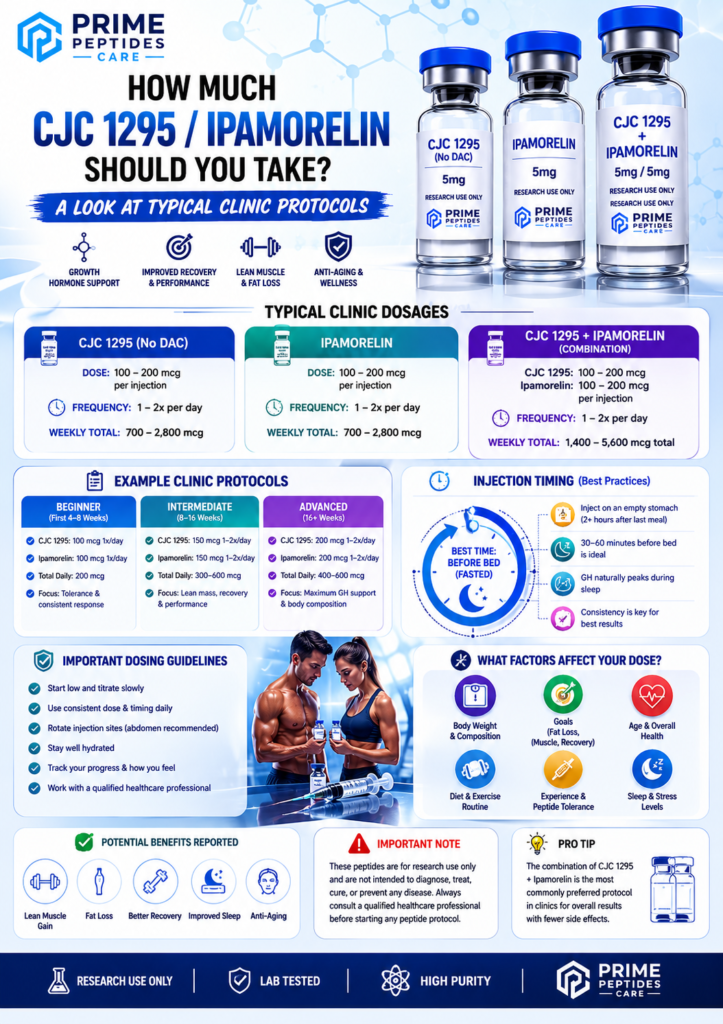
- CJC 1295: often in the 100–300 mcg per injection range.
- Ipamorelin: often in the 200–300 mcg per injection range.
In many examples, both peptides are given together in a single subcutaneous injection, once per day, especially in the evening. Some guides describe a total daily dose of 100–300 mcg of the blend, used 5–7 days per week over a 3–6 month period under medical supervision.
A few clinics outline “beginner,” “intermediate,” and “advanced” protocols, but they still stay roughly inside this 100–300 mcg window and emphasize starting low, monitoring, and adjusting based on labwork and patient response.
How Clinics Usually Structure a Protocol
Most public clinic guides follow a similar structure:
- Start with a low dose
- Begin near the bottom of the range (for example 100 mcg CJC 1295 + 100–150 mcg Ipamorelin).
- Maintain this for several weeks while monitoring sleep, energy, and lab markers.
- Increase gradually if needed
- Titrate upward in small steps (for example to 200/200 mcg) if the supervising provider feels it is appropriate.
- Some protocols cap the blend around 200–300 mcg per day to balance effect and side‑effect risk.
- Use time‑limited cycles
- Commonly 3–6 month “on” periods, sometimes with short breaks or reassessment blocks.
- The goal is to respect the body’s natural feedback loops rather than pushing growth hormone pathways indefinitely.
- Subcutaneous injections on an empty stomach
- Injections are usually just under the skin in areas with more fat (abdomen, flank, thigh, upper arm).
- Many guides recommend dosing at night before bed to align with natural growth hormone pulses, with no food 1–2 hours before and 30–90 minutes after.
Again, all of this comes from what clinics describe publicly; it must not be used as a DIY protocol.
Why “More” Is Not Always Better
With growth hormone–related peptides, simply increasing the dose can backfire:
- Receptor saturation: after a certain point, higher doses yield little extra effect but more risk.
- Side effects: water retention, joint discomfort, headaches, flushing, or changes in blood sugar tend to increase with aggressive dosing.
- Feedback suppression: pushing the axis too hard for too long may reduce natural production over time.
That is why high‑quality guides stress conservative, medically supervised dosing instead of “mega‑dose” cycles.
Safety, Monitoring, and Legal Considerations
Even though many blogs share dosage numbers, they also highlight critical safety steps:
- Pre‑treatment health evaluation (medical history, physical exam, baseline labs).
- Regular monitoring of IGF‑1, fasting glucose, lipids, and other markers.
- Extra caution or outright avoidance in people with cancers, severe heart disease, uncontrolled diabetes, or pregnancy.
- Strict awareness of drug interactions (thyroid meds, steroids, insulin, other hormone therapies).
For peptide stores like Prime Peptides Care, the focus is different: products are labeled and sold strictly as research chemicals. They are intended for controlled in‑vitro or laboratory use by qualified researchers, not for self‑administration or unsupervised “biohacking.”
How This Information Helps Researchers
If you are a researcher, understanding clinical dose ranges can help you:
- Design in‑vitro experiments that mirror realistic exposure levels instead of extreme concentrations.
- Create models that simulate pulsatile vs sustained growth hormone stimulation.
- Translate human clinic patterns into controlled lab conditions for mechanistic studies.
For non‑researchers reading this, dosage content should be treated as context, not instructions. Any real‑world use must go through a licensed healthcare provider who can evaluate risks and benefits in detail.
Quick Takeaway
- Most clinic protocols publicly discuss 100–300 mcg per day of a CJC 1295 / Ipamorelin blend, once daily, often at night and on an empty stomach.
- They stress start low, go slow, use time‑limited cycles, and always work under medical supervision.
- Research suppliers like Prime Peptides Care provide these compounds for in‑vitro research only, not for human or veterinary use.
