
Growth Hormone Peptides
Best Peptides to Stack with CJC 1295 Ipamorelin
Jun
CJC 1295 and Ipamorelin are already a classic growth hormone peptide stack on their own, so it makes sense that many researchers ask which peptides pair best with this combo. In this guide, the focus stays on laboratory and in‑vitro research use, while explaining why certain stacks are so popular in online “Wolverine‑style” recovery discussions.
Why CJC 1295 + Ipamorelin Is the Classic Base Stack
CJC 1295 is a growth hormone–releasing hormone (GHRH) analog, while Ipamorelin is a selective growth hormone secretagogue that acts on ghrelin receptors. Together, they are often used in research models to study both sustained and pulsatile growth hormone release.
Because this combination targets different points in the growth hormone axis, it has become a natural “base stack” that other peptides are added to in order to explore recovery, body composition, and metabolic pathways under controlled conditions.
The Wolverine‑Style Concept: Adding Repair Peptides
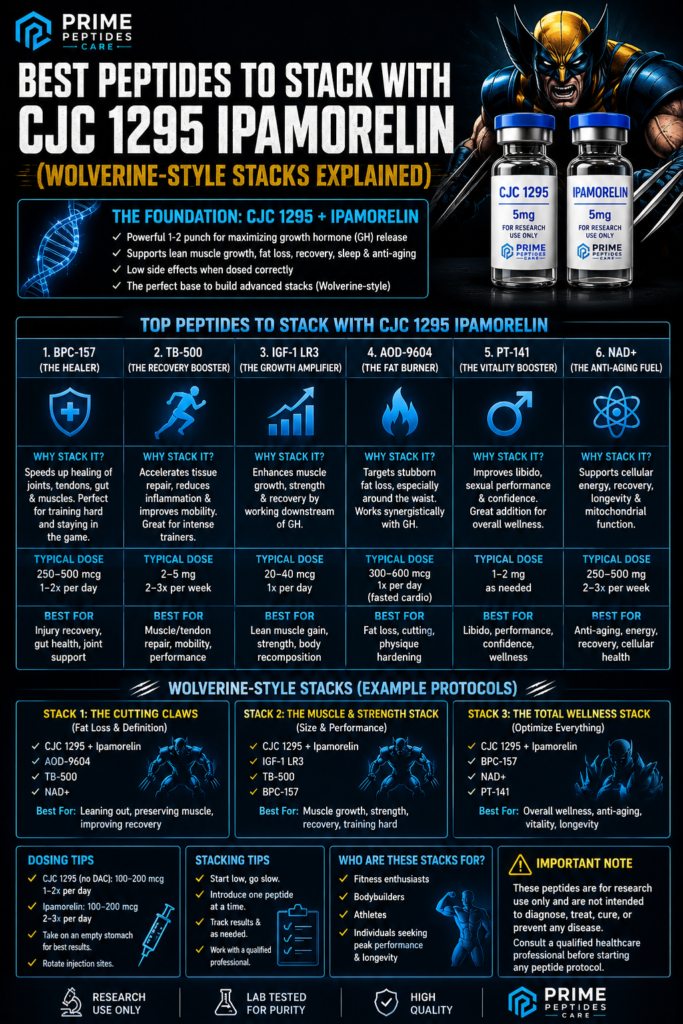
When people online talk about a “Wolverine stack,” they are usually referring to growth hormone–related peptides combined with compounds studied for tissue protection and repair. In research terms, that often means adding peptides like BPC‑157 and TB‑500 on top of a CJC 1295 / Ipamorelin foundation.
BPC‑157 – Tissue and Gut‑Focused Research
BPC‑157 is a synthetic pentadecapeptide derived from a protective protein found in gastric juice. In experimental models, it is frequently used to investigate:
- Cellular repair and signaling pathways
- Angiogenesis and blood‑vessel support
- Gastrointestinal mucosal protection and integrity
Stacking BPC‑157 with CJC 1295 / Ipamorelin allows researchers to explore how growth hormone–related signaling and local tissue repair pathways might interact in the same study.
TB‑500 – Cell Migration and Structural Support
TB‑500 (a fragment of Thymosin Beta‑4) is another popular repair‑oriented peptide in the Wolverine‑style stack. In research models, it is commonly examined for:
- Effects on actin and cell migration
- Support of tendon, ligament, and muscle tissue studies
- Potential roles in recovery and structural remodeling
Combining TB‑500 with BPC‑157 and a CJC 1295 / Ipamorelin base creates a multi‑pathway research stack that touches growth hormone signaling, angiogenesis, and cytoskeletal dynamics.
Other Peptides Commonly Stacked with CJC 1295 Ipamorelin
Beyond BPC‑157 and TB‑500, several other peptides frequently appear in research‑oriented stacks with CJC 1295 / Ipamorelin.
H3: GHK‑Cu – Skin and Collagen Pathway Research
GHK‑Cu is a copper‑binding tripeptide often studied for its role in skin quality, collagen support, and hair‑related pathways. When combined with CJC 1295 / Ipamorelin, researchers may be interested in:
- How systemic growth‑hormone‑related signaling interacts with local skin and extracellular matrix pathways
- Cosmetic and aesthetic‑focused experimental models under in‑vitro conditions
This is the “glow” angle in many blends pairing GH‑related peptides with a copper peptide to study surface appearance and structural proteins.
Metabolic‑Focused Peptides (e.g., AOD‑9604)
Some stacks layer in peptides that have been studied for fat metabolism and weight management, such as AOD‑9604 and similar fragments. In that context, CJC 1295 / Ipamorelin may serve as the growth hormone–axis base, while the additional peptide targets more specific lipolysis or metabolic pathways.
Building a Safe, Research‑Only Stack Framework
Even when talking about popular stacks, it is important to keep the focus on scientific use and regulatory compliance.
- Start simple: In a lab setting, many protocols examine CJC 1295 / Ipamorelin by themselves first, then add a single repair peptide before moving to larger stacks.
- Control variables: Each added peptide introduces new pathways and potential confounders, so careful experimental design and control groups are essential.
- Follow storage and handling protocols: Lyophilized peptides typically require cold storage, protection from light, and sterile technique during reconstitution.
All peptides from Prime Peptides Care are intended strictly for in‑vitro research use only. They are not for human or veterinary use and should never be misused as food, drugs, or cosmetic products.
Example Wolverine‑Style Stack for Research Discussion
A common example people talk about online looks like this:
- Base: CJC 1295 + Ipamorelin (growth hormone–axis focus)
- Repair layer: BPC‑157 + TB‑500 (tissue and structural research)
- Optional aesthetic layer: GHK‑Cu (skin and collagen‑related research models)
From a research perspective, this type of stack allows scientists to examine short‑term and longer‑term changes in markers related to growth hormone, cell migration, angiogenesis, extracellular matrix components, and tissue integrity all within a single experimental framework.
Final Thoughts: Start with the Classic Stack, Add Repair Wisely
CJC 1295 / Ipamorelin remains the classic “engine” of many growth hormone–focused research stacks. Adding repair‑oriented peptides like BPC‑157, TB‑500, and GHK‑Cu helps build a Wolverine‑style concept that targets multiple pathways at once. For serious laboratories and researchers, the key is not just which peptides are included, but how carefully each variable is controlled, documented, and kept within research‑only boundaries.
