
Growth Hormone Peptides
CJC 1295 Ipamorelin Before and After: What Real Users Report vs. Research Data
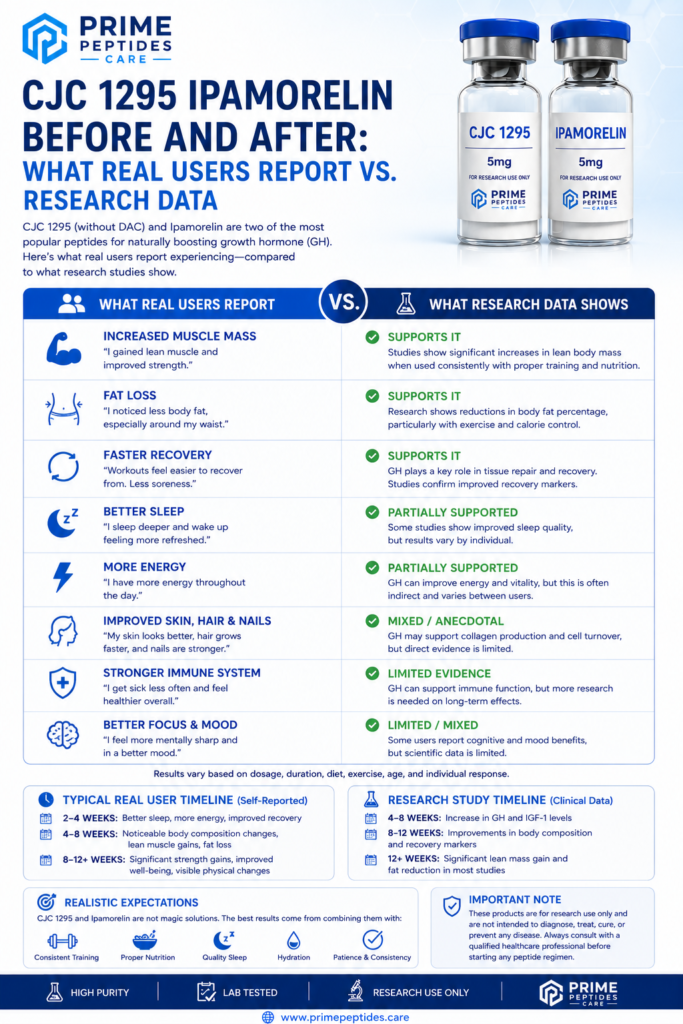
Jun
Why “Before and After” Stories Matter
Search for “CJC 1295 Ipamorelin before and after” and you’ll find dramatic photos and big promises. Many people talk about better sleep, faster recovery, fat loss and more visible muscle over several months of use. At the same time, the actual research behind growth hormone related peptides is much narrower and more controlled than most marketing suggests. This post separates common user reports from what current data shows, so readers understand where the science stops and the hype begins.
Note: All peptide products at Prime Peptides Care are sold for in‑vitro research use only, not for human or veterinary use.
Part 1: What CJC 1295 and Ipamorelin Are
CJC 1295 is a growth hormone releasing hormone (GHRH) analog that signals the pituitary to produce more of its own growth hormone over a longer period. Ipamorelin is a growth hormone secretagogue that binds to ghrelin receptors and triggers short growth hormone pulses. When combined, the stack is intended to create higher‑but‑still‑pulsatile GH signaling rather than flat, constant levels.
In simple terms, many clinics describe it this way:
- CJC 1295 helps the “factory” make more growth hormone.
- Ipamorelin helps the “warehouse” release it in pulses.
This is why so many before‑and‑after stories link the combo to changes in sleep, recovery, and body composition over time.
Part 2: What Real Users Commonly Report
If you look at clinic blogs, YouTube reviews, Reddit threads, and Instagram transformations, the same themes appear again and again:
Weeks 1–4 (early phase)
- Deeper, more restorative sleep and feeling more rested in the morning.
- Slight increase in daily energy and motivation.
- Some users notice faster post‑workout recovery and less soreness, but little visible change in the mirror yet.
Months 2–3 (visible changes start)
- Gradual reduction in stubborn belly fat and a “leaner” midsection.
- Sharper muscle definition when combined with training and a decent diet.
- More consistent workout performance, higher work capacity, and less fatigue.
- Subtle skin changes: users often mention a “healthier glow” or smoother look.
Months 4–6 and beyond (bigger transformations)
- Noticeable recomposition: lower body fat and more lean mass in progress photos.
- Stronger recovery, ability to train harder or more frequently.
- People talk about renewed “youthful energy,” better confidence, and sharper focus.
Commonly reported side effects are usually mild:
- Temporary water retention or puffiness.
- Occasional tingling in hands/feet.
- Redness or irritation at injection sites.
All of this is self‑reported and usually comes from people also changing diet, training, sleep, and sometimes stacking other compounds so it’s impossible to credit peptides alone.
Part 3: What Research Data Actually Shows
Human and animal research paints a more cautious, measured picture than dramatic before‑and‑after photos. Controlled studies on CJC 1295 show that it can raise growth hormone and IGF‑1 levels for days after administration, with dose‑dependent increases. Ipamorelin has been studied as a selective secretagogue that triggers growth hormone release without strongly affecting cortisol or prolactin, which is why it is considered “cleaner” than older growth hormone releasing peptides.
Importantly:
- Clinical data focuses on hormone levels, pharmacokinetics, and lab markers, not six‑pack abs or viral transformations.
- Many peptides, including some popular in online communities, still lack large, well‑controlled long‑term human trials on outcomes like fat loss, muscle gain, or longevity.
- Recent regulatory statements in North America and Europe have warned that many “grey‑market” peptide products are unapproved drugs and may not match the label in purity or dosage.
In other words, research supports meaningful changes in GH/IGF‑1 signaling under controlled conditions, but evidence for long‑term cosmetic or performance outcomes in the general population is limited and still evolving.
Part 4: Why Before‑and‑After Photos Can Mislead
Before‑and‑after content gets clicks, but it has several problems:
- Multiple variables change at once – people often start training harder, sleeping more, and cleaning up their diet right when they start peptides.
- Placebo and motivation effects – investing money and effort in a protocol can push someone to live healthier overall, which itself explains much of the change.
- Selective publishing – people with great results post pictures; those with no change or side effects rarely go viral.
- Different products and quality – not all peptides sold online are properly dosed or tested, so experiences vary widely.
For responsible education, it’s better to treat before‑and‑after stories as anecdotes, not proof.
Part 5: How to Think Critically About Results
For readers researching CJC 1295 and Ipamorelin, a balanced mindset helps:
- Look for sources that show lab data (GH/IGF‑1 levels, study design, sample size) instead of only photos.
- Be wary of anyone promising guaranteed transformations or using peptides as a shortcut instead of emphasizing training, nutrition, and sleep.
- Understand that unapproved peptide products labeled “for research use only” are not intended for human use, even if influencers talk about them as shortcuts.
- Remember that long‑term safety, optimal protocols, and true effectiveness are still being clarified in ongoing research.
For Prime Peptides Care, the correct positioning is to provide high‑purity compounds for in‑vitro research, plus transparent information that respects both science and regulations.
Closing: Where Prime Peptides Care Fits In
Prime Peptides Care focuses on supplying clearly labeled, high‑purity research peptides for laboratories and qualified professionals. Educational articles like this help distinguish between what real users are saying online and what current research actually supports. All products are sold strictly for in‑vitro research use only, not for human or veterinary use, and should be handled according to appropriate lab protocols.
